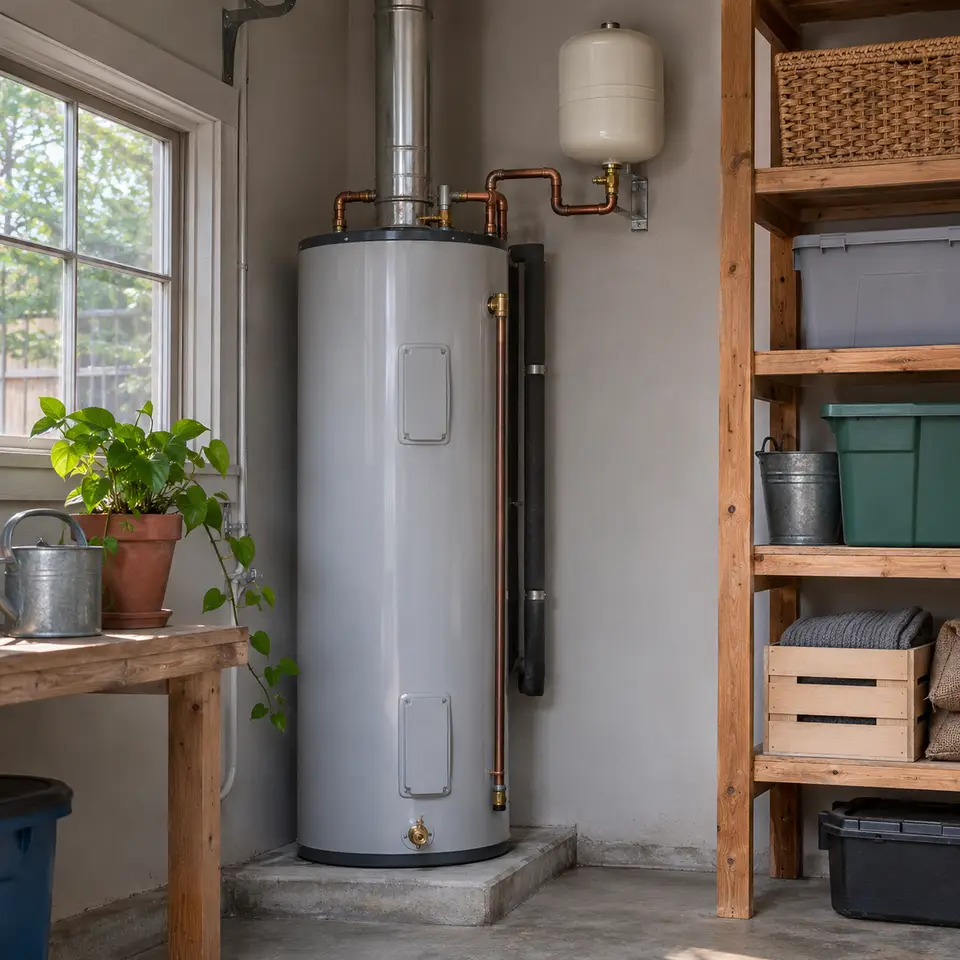
How Long Does a Water Heater Last? Age and Signs of Wear
Find your tank ageHow long a water heater lasts depends on the tank, the water and the care it gets, and a few signs tell you when it is near the end.
How long does a water heater last on average?
So how long does a water heater last? Tank models often run around eight to twelve years. Some fail sooner and some keep going well past that range.
- What shortens the life
- Sediment left in the tank, high water pressure, a temperature set very high and a worn anode rod that is never replaced.
- What lengthens it
- Flushing the tank once a year, checking the anode rod every few years and keeping the pressure in a normal range.
- What makes no difference
- How often you use hot water matters less than how well the tank is looked after.
Age alone does not mean a tank must be replaced. It means it is worth watching more closely.
Reading the age from the label
Every tank has a label on its side with a serial number. Most makers code the year, and often the month, into that number.
- Find the labelIt is usually on the upper part of the tank, facing out.
- Look at the serial numberMany brands use a letter for the month and digits for the year, or the year in the first few digits.
- Check the maker's patternEach brand codes it differently. If you are unsure, take a photo of the label.
If you cannot work it out, show the photo to the plumber during a visit. They can read the date and tell you how the tank looks for its age.
Signs a tank is wearing out
Rusty hot water
Rust colored water from the hot taps only can mean the inside of the tank is corroding.
Rumbling and popping
Thick sediment at the bottom makes noise as water heats through it, and wears the tank.
Moisture around the base
Water near the bottom of the tank can be a valve or the tank itself starting to fail.
Less hot water than before
Sediment takes up room in the tank, so hot water runs out sooner.
Frequent repairs
A string of fixes close together usually signals a tank on its last legs.
Corroded fittings on top
Crusty, rusty connections can point to slow leaks and age.
Repair or replace by age and symptom
This table is a rough guide. The plumber looks at the actual condition before suggesting anything.
| Situation | Usually |
|---|---|
| Younger tank, a failed igniter, element or thermostat | Repair |
| Younger tank, a dripping drain valve or fitting | Repair |
| Older tank, rusty hot water and rumbling | Plan a replacement |
| Any age, water leaking from the tank body | Replace |
| Older tank, a single minor fault, otherwise sound | Repair, and keep watching |
Our water heater repair page covers the common repairs in more detail.
Habits that keep a tank going longer
- Drain the sediment out of the tank every year.
- Get the anode rod looked at every few years and swapped once it has thinned out.
- Once a year, raise the relief valve lever briefly and let it snap back, proof that it still opens.
- Keep the temperature at a comfortable, moderate level.
- Ask the plumber to check the house water pressure, since high pressure strains the tank.
If a fitting on top of the tank is leaking, it can drip into a garage or closet unseen for a long time. A quick look during routine checks catches it early.
Planning for a replacement before it fails
A tank that fails suddenly can flood a garage or closet. If your tank is older and showing warning signs, planning ahead avoids a cold shower and a wet floor.
- Know where the tank is and how to shut off its water and power or gas.
- Keep the area around it clear so a leak is easy to spot.
- Check the base of the tank every month or so.
- Talk to the plumber about timing at your next visit.
If you ever see water around the tank, the plumbing emergency first steps guide explains what to close first, and our leak detection page covers leaks you cannot trace.
Where the water heater sits matters
Tanks in garages are easy to see and check. Tanks tucked into closets or under stairs can leak for a long time before anyone notices, and the damage reaches walls and floors.
If your tank is in a closet, check it more often, keep the floor around it clear and make sure the relief valve pipe runs somewhere safe. A drain pan under the tank adds a little protection, and a plumber can fit one during a repair.
Gas and electric tanks age differently
Both kinds of tank wear out in the same main way, by corrosion inside the tank. The parts around the tank age differently.
Gas tanks
- Burners collect dust and soot over the years
- Thermocouples and igniters wear and are often replaced once or twice
- The flue needs to stay clear and properly connected
- Sediment noise is often louder because heat comes from below
Electric tanks
- Heating elements can burn out, especially in hard water
- Thermostats can fail and cause water that is too hot or cold
- Sediment can bury the lower element and shorten its life
- Breakers can trip when an element fails
A failed part on either kind is usually worth repairing on a tank that is otherwise sound.
What to tell the plumber about an older tank
How long does a water heater last in your particular house? A few details help the plumber judge whether a repair makes sense.
- The age
- From the serial number, or the year you moved in if you are not sure.
- Past repairs
- Any parts replaced before, such as an element, a thermocouple or a valve.
- What changed
- Less hot water, new noises, rusty water or water at the base.
- The location
- A garage, closet, attic or crawl space, which affects how risky a leak would be.
With this information the plumber can give a clear answer on repair or replace, rather than guessing.
Water quality and tank life
Over the years, minerals carried in the water collect as a gritty layer on the tank floor. The layer makes a gas burner work harder and can shorten the life of an electric element.
- Yearly flushing removes most of the loose sediment.
- A fresh anode rod slows corrosion inside the tank.
- Correct house pressure reduces strain on the tank and its valves.
- An expansion tank, where one is needed, protects the heater from pressure spikes.
Water heater age questions
Age
How long does a water heater last?
Most tanks manage eight to twelve years, shaped by the water, the pressure and the upkeep. Yearly flushing and a new anode rod can stretch that further.
Is a ten year old water heater worth repairing?
It can be, if the problem is a simple part and the tank shows no rust or leaks. If it has several warning signs, replacement may be wiser.
Signs and care
Why does my hot water look rusty?
If only the hot water is rusty, the tank or its anode rod is likely corroding. If cold water is rusty too, the pipes may be the cause.
Does flushing really help an old tank?
Flushing helps a tank that has been looked after. On a very old tank with heavy sediment, flushing can stir things up, so ask the plumber first.
What is an anode rod?
It is a metal rod placed in the tank to corrode in place of the steel. When it has been eaten away, the steel shell starts rusting instead.
Does hard water shorten a water heater life?
Minerals in hard water settle as sediment in the tank and on electric elements, which wears them faster. Regular flushing helps.
Can a water heater fail without warning?
Sometimes, but most give signs first, such as rumbling, rusty hot water, less hot water or moisture at the base. Watching for them gives you time to plan.
Is a tankless water heater longer lasting?
Tankless units often last longer than tanks, but they need regular descaling. If you have one, mention it when you call.
Can an old water heater stay in service?
Yes, as long as it heats normally, does not leak and the relief valve works. Keep watching for rust, noise and moisture as it ages.
How often should the anode rod be checked?
Every few years is a good rhythm, more often with hard water. A plumber can pull it and show you how much is left.
Why does my water heater leak only sometimes?
An occasional drip can come from the relief valve releasing pressure when the water heats. That valve, or high house pressure, should be checked.
What is the safest way to check a tank that is in a closet?
Open the closet door, look at the floor around the base and the fittings on top, and feel for dampness. Do not move the tank or the gas line. If the floor is wet, close the cold supply valve and call.
Does the temperature setting affect how long the tank lasts?
A very high setting speeds up wear and scale buildup. A moderate setting is easier on the tank and safer for everyone in the house.
Should I replace the water heater and the valves around it together?
When a tank is replaced, the plumber checks the valves and connections around it and replaces worn ones at the same time, since they are already being worked on.
Does a water heater last longer indoors than in a garage?
Care matters more than location, but a garage exposes the tank to colder air, so it works a little harder in winter. Keeping the area clear and dry helps.
Can an old tank be flushed for the first time?
It can, but a tank that has gone years without flushing can hold heavy sediment that clogs the drain valve. The plumber can flush it safely and check the valve afterward.
What happens to the old tank when it is replaced?
Ask about removal on the call, since the plan for the old tank is agreed before any work starts.