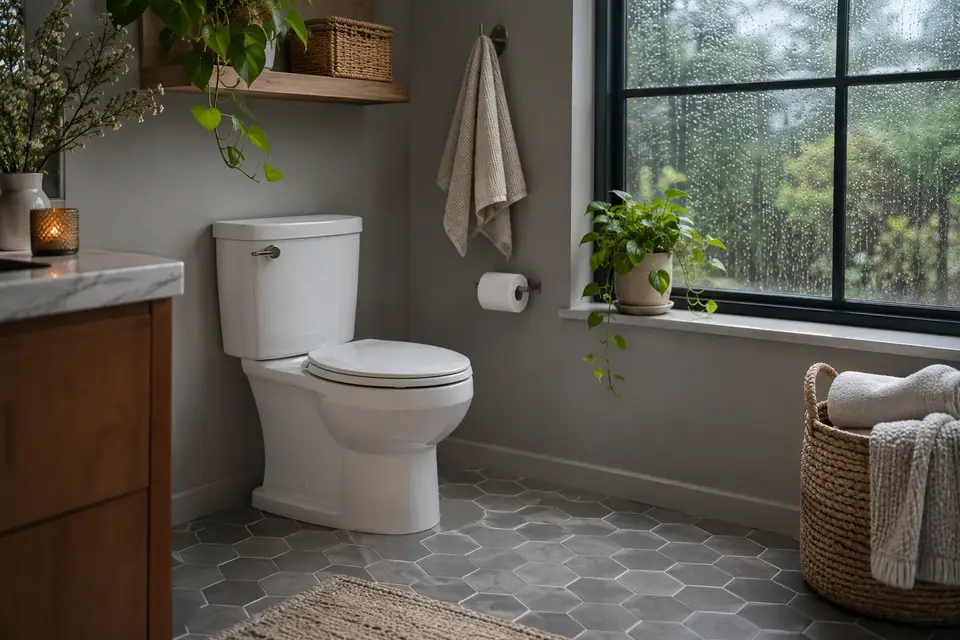
Toilet Repair in Oregon City, OR
Find the part behind the problemIf your toilet runs on its own, rocks when you sit, overflows or leaks at the base, a licensed plumber can come out and fix it.
What is wrong with the toilet, and why
Toilet repair in Oregon City usually comes down to one worn part. This table matches the problem with the part most often behind it.
| The problem | The usual cause | How urgent |
|---|---|---|
| Runs or refills every few minutes | A worn flapper letting water into the bowl | Wastes water, fix soon |
| Keeps running after a flush | A fill valve stuck open | Wastes water, fix soon |
| Weak or incomplete flush | A partial clog, a low water level or a worn flapper chain | Annoying, not urgent |
| Rocks when you sit | Loose floor bolts or a worn wax seal | Fix soon to protect the floor |
| A wet floor at the base | A worn wax ring, now and then a crack | Fix right away |
| Clogs again and again | A partial clog in the toilet or the drain beyond it | Fix soon |
What to do when a toilet overflows
A rising bowl is stressful, but you can stop it in seconds.
- Close the supply valveTwist the little valve behind the toilet to the right and the tank stops filling.
- Hold the flapper shut if the valve sticksTake the tank lid off and press the flapper down to stop water entering the bowl.
- Do not flush againWait for the water level to drop before trying anything else.
- Try a flange plungerFor a simple clog, a few firm strokes with a flange plunger often clears it.
If the toilet overflows again, or other drains gurgle when it is flushed, stop and call. The clog may be further down the drain.
A running toilet wastes more water than you think
A toilet that runs quietly in the background can waste a large amount of water every day. It is also one of the quickest repairs a plumber makes.
- Check the flapper
- Drip some food dye into the tank and leave it alone. Color creeping into the bowl inside a quarter hour, with no flush, means the flapper leaks.
- Check the water level
- If water runs into the overflow tube in the middle of the tank, the fill valve is set too high or not shutting off.
- Listen for refilling
- A short refill every few minutes with nobody flushing is a classic sign of a leaking flapper.
If the dye test shows a leak, the fix is usually a new flapper or fill valve. The plumber checks the other tank parts while the lid is off.
Why a leak at the base cannot wait
A wet base usually traces back to the wax ring sitting between toilet and drain. Every flush squeezes a bit of water out underneath, straight into the subfloor.
Over time that can soften the floor, stain the ceiling below and cause a musty smell. In a home with a crawl space, it can also add to damp under the house.
How the plumber repairs a toilet
Tank parts
Flappers, fill valves, flush valves and handles are replaced and adjusted so the tank fills and stops cleanly.
Seals and bolts
For a rocking or leaking toilet, the plumber lifts it, replaces the wax seal and tightens it down on solid bolts.
Clogs
A toilet auger clears clogs that a plunger cannot reach without scratching the bowl.
Supply lines
Old or kinked supply lines and stuck shutoff valves behind the toilet are replaced.
Spotting a crack in the porcelain changes the plan, and the plumber will say so, because cracked toilets get replaced, not patched.
Keeping toilets trouble free
- Send nothing but toilet paper down. So called flushable wipes still jam drains.
- Test the shutoff valve behind each toilet once a year so it turns when you need it.
- Fix a running toilet early, before a worn part fails completely.
- Avoid tablets that sit in the tank, which can wear out rubber parts faster.
Frequent clogs can mean a half blocked pipe beyond the bowl. See drain cleaning for how the plumber opens the line.
Toilet parts in plain words
Knowing the names of the parts makes it easier to describe the problem and understand the repair.
- Flapper
- The rubber cover at the bottom of the tank that lifts to flush and drops to hold water in.
- Fill valve
- The upright valve at one end of the tank, refilling it and shuts off when the water is high enough.
- Flush valve
- The opening the flapper seals, with the overflow tube rising from it.
- Wax seal
- The ring under the toilet that seals it to the drain in the floor.
- Supply line
- The short flexible line from the wall valve to the tank.
- Closet bolts
- The two bolts at the base that hold the toilet down to the floor.
Older toilets and newer low flow models
Toilets made in different decades use very different amounts of water, and their parts are not always interchangeable.
- Older tank toilets
- These use more water per flush and often take standard parts. A worn flapper or fill valve is usually easy to match.
- Newer low flow toilets
- These use far less water and rely on a precise flapper or flush valve. A mismatched part can leave weak flushes or a constant trickle.
- Pressure assisted toilets
- These have a sealed vessel inside the tank and a loud, strong flush. Their cartridges need specific replacement parts.
If you know the make of your toilet, mention it on the call. The name is usually stamped inside the tank behind the water line.
Questions about toilet repair in Oregon City
Running and flushing
What keeps a toilet running?
Nine times out of ten, a leaky flapper or a fill valve stuck open. Both are common, quick repairs.
Why is my flush weak?
A low water level in the tank, a partial clog or a chain that is too long can all weaken a flush. The plumber checks each one.
Leaks and rocking
Should I worry about a toilet that wobbles?
Yes. Each wobble wears the wax seal and lets water reach the floor. Tightening or resetting it early protects the subfloor.
Can I just caulk around the base to stop a leak?
Caulk can hide a leak rather than stop it. If the seal under the toilet has failed, it needs replacing.
Why is there water on the floor only sometimes?
If it appears after flushing, suspect the seal. If it appears on humid days, it may be condensation on the tank. The plumber can tell the difference.
Clogs
Why does my toilet clog so often?
Wipes, too much paper, a partial blockage further down or an older low flow design can all cause repeat clogs.
Can a toilet clog cause a leak at the base?
A clog makes water sit higher in the bowl and can push water past a weak seal. Clearing the clog and checking the seal is the right order.
Should I use chemicals in a clogged toilet?
We would steer away from them. A flange plunger or a toilet auger is safer for the bowl and the pipes.
How long does a toilet repair take?
Most tank part repairs take under an hour. Replacing a wax seal or resetting a rocking toilet takes a little longer.
Should I replace an old toilet that keeps running?
Rarely. Fresh tank parts normally stop the running. A new toilet only makes sense for cracked porcelain or a model whose parts are gone.
Why is my toilet tank sweating?
Warm, humid bathroom air hits the cold tank, and droplets form on the outside. A fan during showers helps, and a tank that also leaks needs a closer look.
Why does my toilet flush weakly?
A partly blocked trap, scale clogging the small holes under the rim or a low water level in the tank are the usual reasons. The plumber checks each before suggesting a fix.
Should the valve behind the toilet be replaced?
Replace it if it is stiff, drips at the stem or will not close fully. A working valve lets you stop an overflow in seconds.